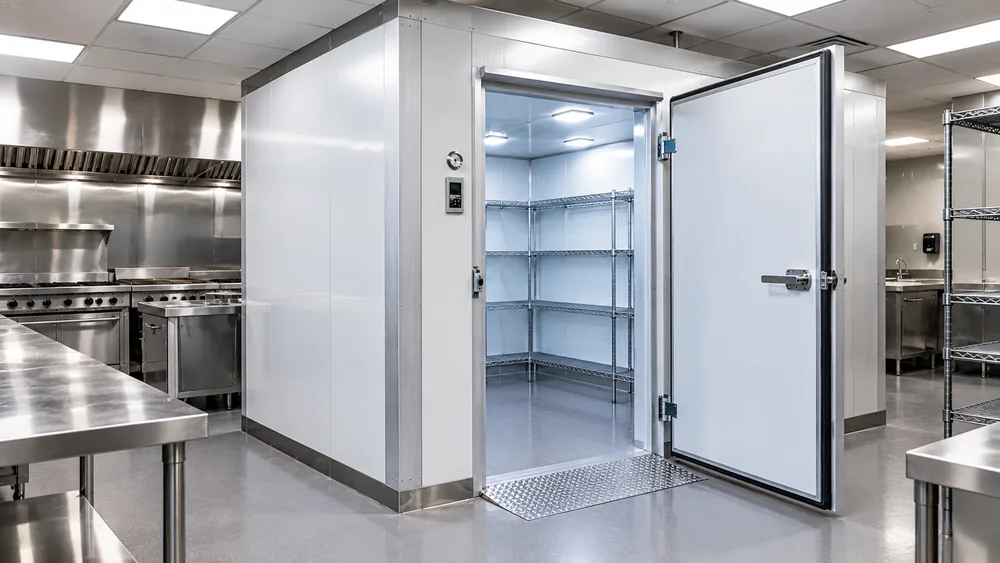
Walk-in coolers
For fresh product held above freezing: produce, dairy, meat before processing, beverages and prepared food. Sizing starts from how much warm product comes in each day, because pulling that heat out is most of the load.
BC Freezer designs and installs walk-in coolers, walk-in freezers, dual-temperature boxes and blast freezers for commercial kitchens, grocery stores, cold storage, food processors and breweries across the Lower Mainland, Fraser Valley and BC Interior. Each system is sized from a heat-load calculation, quoted in writing after a site survey, and commissioned before any product goes in.
From a single restaurant walk-in to multi-zone cold storage. The type of system follows from the product you store and how often the door opens.
For fresh product held above freezing: produce, dairy, meat before processing, beverages and prepared food. Sizing starts from how much warm product comes in each day, because pulling that heat out is most of the load.
Held well below freezing, which means thicker insulation, a heated door frame, an insulated floor and a defrost system sized for the ice a freezer coil builds. Door traffic matters more here than in a cooler.
A cooler and a freezer sharing one insulated box, usually with the freezer entered through the cooler so warm air never reaches it directly. A common fit for kitchens short on floor space.
Built to take product from warm to frozen fast, for food processors, bakeries and pack houses. The refrigeration is sized for pull-down speed rather than holding temperature, so it is its own design, not a larger freezer.
Remote condensing units move compressor heat and noise outside the building. Parallel rack systems run several coolers and freezers from one set of compressors, which suits grocery and cold storage with many loads.
When the box, panels and door are sound but the condensing unit or evaporator has failed or become inefficient, the refrigeration can be replaced on its own. Panel condition is assessed at the survey before this is recommended.
Walk-in cost is set by heat load, not floor size, so two boxes with the same footprint can differ severalfold in installed price. BC Freezer quotes in writing after a free site survey rather than publishing a price list. These are the factors that set your number.
| Factor | Why it changes the price |
|---|---|
| Heat load | Set by what you store, how much arrives each day and how often the door opens, not by floor area. |
| Temperature range | Cooler, freezer, dual-temperature or blast freezer. A blast freezer is a different machine, not a colder cooler. |
| System type | Self-contained, remote condensing or a parallel rack. The comparison below explains the trade-off. |
| Panels and doors | Insulation thickness, finish, door count and hardware. |
| Electrical capacity | Whether the existing service carries the load, or an upgrade comes with the job. |
| Site access | Roof placement, crane lifts, line-set runs and working around a live operation. |
Equipment specifications, labour and anticipated energy rebate eligibility, itemised line by line. A Red Seal refrigeration mechanic scopes the work from a heat-load calculation, not a salesperson from a catalogue.
The full list of eight cost drivers is on the FAQ page.
Quotes are free, written and carry no obligation.
Six stages from first visit to handover. What usually moves the schedule is found at stage one, before you commit to anything.
A technician measures the space, checks electrical capacity and where a condensing unit can go, and works out the heat load from your product, daily throughput and door openings.
The system is specified to that load and quoted line by line: equipment, labour and any CleanBC rebate the efficiency measures qualify for.
Panels, doors and refrigeration equipment are ordered. Manufacturer lead time is usually the longest single wait in the project, which is why it is confirmed with you at order.
The box is assembled, the condensing unit and evaporator mounted, refrigerant lines run and pressure tested, and controls wired.
The stage cheaper bids skip. Superheat and subcooling are set, defrost is matched to the real load, and the box is pulled down to temperature and held there before it is signed off.
You receive the commissioning record and equipment details, a walk-through of the controls, and the prepared paperwork for any eligible rebate.
Where the heat goes decides most of this. Every compressor rejects heat somewhere, and the choice is whether that is your kitchen, your roof or a machine room.
| Self-contained | Remote condensing | Parallel rack | |
|---|---|---|---|
| Where the compressor sits | On or beside the box | Outside or on the roof | A machine room serving many boxes |
| Heat and noise inside | Released into the room | Kept outside | Kept in the machine room |
| Upfront cost | Lowest | Higher: line sets and roof or wall work | Highest, but shared across loads |
| If a compressor fails | That box is down | That box is down | Other compressors carry the load |
| Usually suits | Small walk-ins where the room can take the heat | Kitchens and stores that cannot | Grocery and cold storage with many loads |
Which one fits is decided at the site survey, from the heat load and where the heat can go.
It depends mostly on three things: equipment lead time, electrical work and permits. All three are identified at the site survey, before you commit to anything.
Whether the existing electrical service can carry a new walk-in is checked at the site survey, so an upgrade is known and priced before you approve anything.
Electrical work in BC usually needs a permit, issued by Technical Safety BC or by your city if it runs its own permitting. Whether your project needs one is identified at the survey.
Usually, yes. Working around a live operation is identified at the site survey and planned into the quote, including which work has to happen outside trading hours and where the condensing unit and line sets can run without closing a service area. It can add cost, which is why it is priced up front rather than discovered on installation day.
Every job carries a parts and labour warranty, with the term stated in writing on your quote. Manufacturer warranty applies separately to the equipment.
Often it can. If the panels are dry, the insulation is intact and the door still seals, replacing only the condensing unit and evaporator costs far less than a new box. Panels that are waterlogged, iced inside or delaminating keep leaking heat whatever refrigeration is fitted, so their condition is checked at the survey before a refrigeration-only replacement is recommended.
Installations are scheduled work, so they reach further than emergency dispatch does. BC Freezer is a Technical Safety BC Class A Refrigeration Contractor based in Surrey, installing across the Highway 1 and Highway 5 corridors.
Equipment installed: Bohn, KeepRite, Heatcraft, Danfoss, Copeland, Goodman / Amana, Daikin, Gree / Tosot, Trent, True, Beverage-Air and Master-Bilt.
Planning a walk-in?
Start with a free site survey and a written, itemised quote.
Thank you. Your request reached our team. We'll reply to .
For an emergency, call 778-893-2222 now.
The form didn't load. Please call 778-893-2222 or email [email protected].
We use these details only to reply to your request.