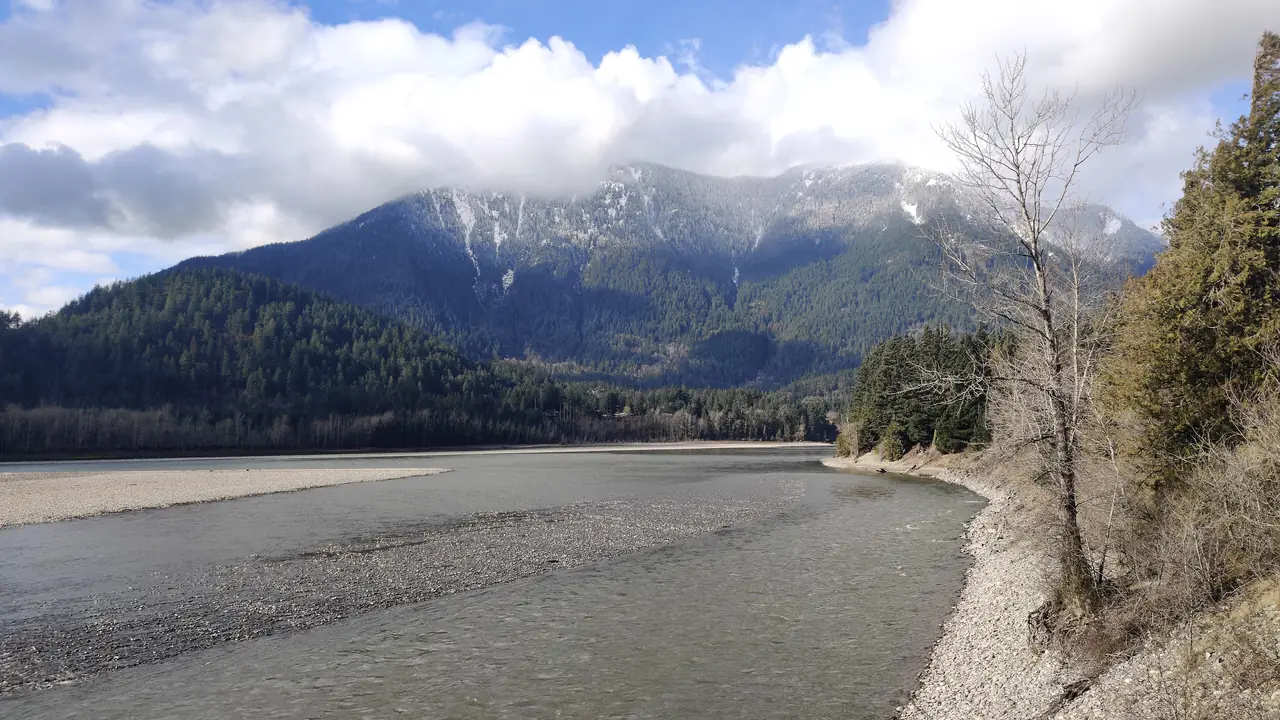
What commercial refrigeration in Hope actually looks like
Hope exists because four highways meet there. Highway 1 arrives from the Fraser Valley and turns north into the canyon, Highway 5 climbs the Coquihalla toward Merritt and Kamloops, Highway 3 heads east to Princeton, and Highway 7 runs back west along the north side of the river. Almost every commercial business in town is downstream of that junction: travel centres and fuel stops at the exits, restaurants and motels for people stopping, and grocery and convenience serving both the town and everyone passing through it. The refrigeration follows the same pattern - display coolers, reach-ins, ice machines and quick-service kitchen equipment, with a smaller number of full walk-ins behind the restaurants and grocers.
That customer base has an unusual load profile, and it is worth being explicit about it. A travel centre display cooler is opened hundreds of times a day, by people who do not work there and do not close it carefully. Ice machines in a highway town run flat out through July and August and barely at all in February. And the business's worst possible day for a failure is a long weekend, because that is when the stock is highest, the staff are busiest and every supplier is closed. Equipment here should be serviced against the summer peak, not against the calendar.
An hour away, and what we do about it
There is no refrigeration contractor based in Hope. Whoever you call is coming from the Fraser Valley or from the Interior, and for us that is 45 to 60 minutes - the longest minute-based window we publish. We would rather print that number than bury it, because every operator in town already knows what the drive is.
What is worth arguing about is not the drive, it is what happens at the end of it. Three things change how we run a Hope call. The first is the phone: we ask more questions before the truck leaves - equipment make and model, what the controller reads, what the product temperature is, what changed - because at this distance a wrong guess about the likely fault costs two hours, not twenty minutes. The second is the truck: it is loaded for that specific fault, plus the common failure parts, rather than for an average call. The third is the visit itself. While a technician is on site in Hope, it is worth checking the rest of the equipment - coils, gaskets, drains, controls, superheat - whether or not it is on the work order, because the marginal cost of that inspection is minutes and the alternative is another hour-long drive in three weeks.
When the highways close
In November 2021, flooding and slides closed every highway out of Hope at once. That is not a hypothetical risk to raise in a marketing paragraph; it is a thing that happened to every business in this town within living memory, and a smaller version of it happens most winters when the Coquihalla shuts. For refrigeration it raises questions that are worth answering while the roads are open rather than after they close: which of your rooms and cases a generator will actually carry and for how long, how long a full walk-in holds without power if nobody opens it, which equipment is carrying stock you could not replace for a week, and what you would move first. We will walk through that with you on a maintenance visit. It costs nothing and it is the single most useful thing a contractor can do for a business in this town.
The failures we see most in this community
Door traffic. On highway-service equipment, the door is the load. Gaskets wear out faster here, self-closers and hinges fail sooner, and a display cooler that is opened constantly on a hot afternoon spends its whole day recovering. Half the "it is not cold enough" calls on this kind of equipment are a gasket, a closer or an air curtain rather than a refrigeration fault.
Weather at both extremes. Hope is one of the wettest places in southern British Columbia and it gets real snow. Water finds outdoor electrical enclosures, drain lines freeze in a way they never do on the coast, and door and frame heaters matter through a longer season. Cold outflow wind funnels through the canyon here too, so the low-ambient head pressure problem described on our Chilliwack page applies in Hope as well, often harder.
Deferred everything. The honest failure mode of a remote town is not an exotic fault - it is maintenance that was postponed because getting somebody out felt like a production. Coils that have not been cleaned in three years, a defrost that has never been checked, a controller nobody has reprogrammed since the equipment was installed. None of that is dramatic, and all of it is why the equipment eventually fails on the August long weekend.
Coverage in and around Hope
Commercial areas in and around Hope, what operates there, and the refrigeration equipment typically found
| Area |
What is there |
Typical equipment |
| Hope town centre |
Restaurants, cafes, pubs, grocers and convenience |
Walk-in coolers, reach-ins, prep tables, display cases, ice machines |
| Highway 1 exits and Flood-Hope Road |
Travel centres, truck stops and fuel plazas |
Display coolers, grab-and-go cases, ice machines, quick-service refrigeration |
| Highway 5 Coquihalla junction |
Fuel, quick service and freight staging |
Reach-in display coolers, small walk-ins, ice machines |
| Highway 3 toward Princeton |
Motels, restaurants and seasonal highway commercial |
Reach-ins, undercounters, bar coolers, small walk-ins |
| Silver Creek and Othello |
Rural commercial, campgrounds and small food service |
Reach-ins, chest freezers, small walk-in coolers |
| Laidlaw and Highway 7 west |
Rural grocers, resorts and seasonal operations |
Walk-in coolers, display coolers, ice machines |
| Yale and the canyon north |
Seasonal tourism food service and small grocery |
Reach-ins, undercounters, small cold rooms |
Why Hope gets a 45 to 60 minute window
It is the drive, and nothing else. Hope is the far end of the Fraser Valley: the run out from our Surrey base is Highway 1 all the way, and the last stretch past Chilliwack is most of the difference between a Chilliwack call at 30 to 45 minutes and a Hope call at 45 to 60. Nothing about the town makes it slower once you are there - it is small and everything is near the junction. What does change the number is weather and highway condition, which in this corridor is not a minor caveat. When the roads are bad, we will tell you what the real arrival time is instead of repeating the published one.
Those windows are service targets under normal road and weather conditions, not guarantees. Snow, a highway closure or two emergencies at once will move them, and in this corridor a closure can move them by a day. Where you need a contractual response time, that belongs in a written priority service agreement. See our terms of service.
What we work on here
Display and grab-and-go coolers, walk-in coolers and freezers, reach-ins and undercounters, prep tables, ice machines, bar and back-bar systems, small cold rooms, rooftop and remote condensing units, and commercial kitchen ventilation. We service equipment regardless of who installed it. Full detail is on the emergency repair page and the walk-in installation page, and the pricing and lead-time questions are answered on our FAQ.
Check us before you call
You should not have to take a contractor's word for any of this. Three public records let you check BC Freezer in a few minutes, and they work just as well for any other contractor you are comparing us with.
-
Licence
Technical Safety BC register
Refrigeration contractors in BC must be licensed by Technical Safety BC. The public register shows each contractor's licence number, status and any enforcement action.
Search the register
-
Coverage
WorkSafeBC clearance letter
A clearance letter confirms a business is registered with WorkSafeBC and its premiums are in good standing. Most can be pulled online at no charge.
Get a clearance letter
-
Reviews
Google Business Profile
Reviews there are written by customers and published by Google, not by us. Read them before you book.
Read our Google reviews