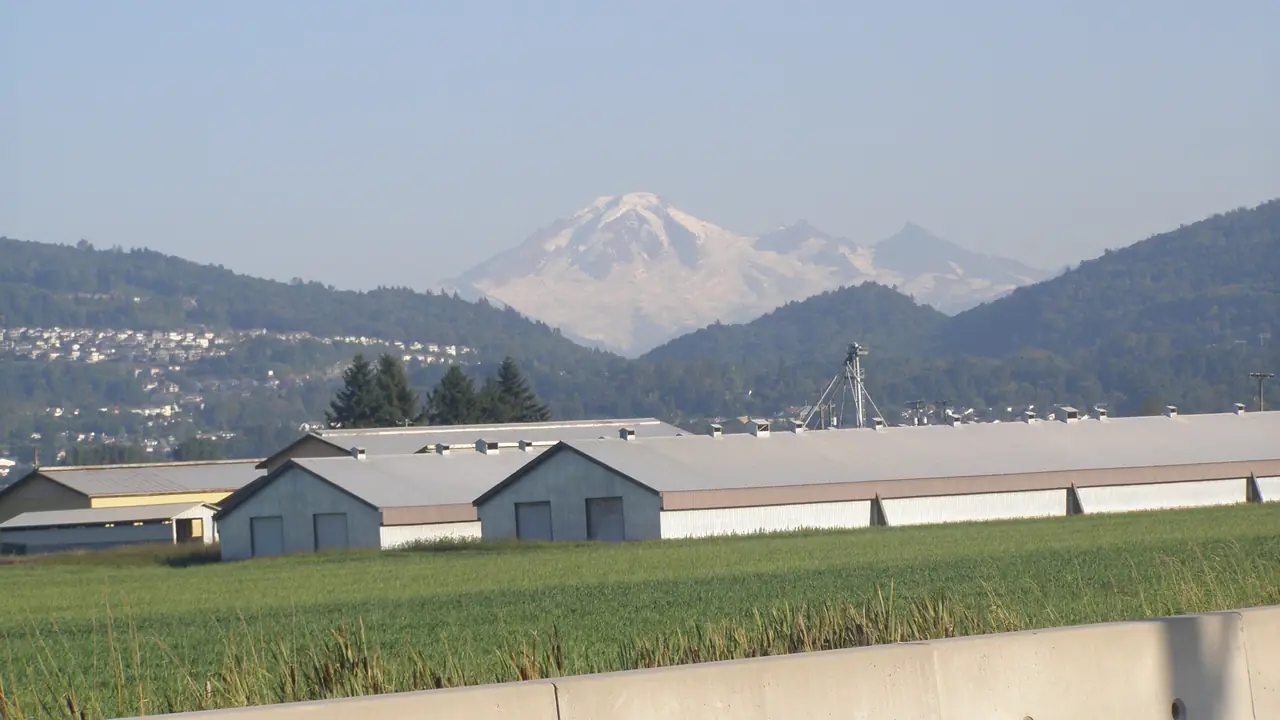
What commercial refrigeration in Abbotsford actually looks like
Abbotsford is the largest agricultural producer in British Columbia, and that single fact changes the whole shape of the refrigeration work here. In most cities we serve, cold equipment exists to keep food saleable for a few days at the end of the supply chain. In Abbotsford a great deal of it sits at the start of the chain: cooling raw milk on the farm, chilling poultry in a processing plant, freezing berries within hours of picking, and holding cut flowers at a temperature and humidity that decides whether they are worth anything at all in three days' time. The equipment is bigger, the tolerances are tighter, and the consequence of a failure is measured in a production run rather than a dinner service.
The city is split by Highway 1 running east to west and by Highway 11, Sumas Way, running north from the Mission Bridge down to the Huntingdon border crossing. Those two roads carry the industrial half of Abbotsford: food processing and cold-chain freight along Sumas Way, distribution and manufacturing around the Abbotsford International Airport and the Mt. Lehman interchange, and highway commercial out at Whatcom Road. The farm half is at the two ends: the Matsqui Prairie in the north-west and the Sumas Prairie in the south-east. The ordinary commercial refrigeration - supermarkets, delis, restaurants, coffee shops - is concentrated through Clearbrook, Sevenoaks and the historic downtown.
Agricultural refrigeration, which is its own trade
Bulk milk cooling. A dairy's bulk tank is regulated equipment. Raw milk has to be brought down and held cold to stay saleable, and a tank that stops cooling puts a shipment at risk within hours - not the following week. Plate coolers foul, tank evaporators lose charge, agitators and controls fail, and the farm usually finds out at the worst possible point in the milking cycle. A dairy call is dispatched as an emergency for that reason, and it is worth telling us it is a bulk tank when you phone rather than after we arrive.
Poultry. Abbotsford carries one of the densest concentrations of poultry production in Canada, and the refrigeration runs from hatchery and egg-grading cool rooms up to processing chill and blast freezing. The distinctive maintenance problem is physical: feather and litter dust is fine, light and everywhere, and it blankets an air-cooled condenser faster than kitchen grease ever fouls one. A condenser that was clean in April is insulated by August, head pressure climbs, capacity drops, and a plant that has been quietly losing performance all summer fails on the hottest week of the year.
Berries and produce. Raspberry and blueberry ground around Abbotsford is some of the most productive in the country, and the cooling that goes with it is brutally seasonal. Pre-cooling, packing-house cold rooms and IQF or blast freezing carry almost no load for most of the year and then run at capacity for a few weeks in July and August. Equipment that is only truly loaded once a year is equipment that does not get to reveal a marginal fault until the day it matters. Pre-season service on that gear pays for itself in one avoided afternoon.
Floriculture and greenhouse. Cut-flower and bulb storage is the tightest control work in the city. The product needs a low holding temperature with high relative humidity, and a coil running colder than it should strips moisture out of the air and dries the stock instead of preserving it. Getting that right is a matter of coil temperature difference, air throw and defrost strategy rather than raw capacity, which is why a flower cooler that "works" can still be costing the grower product every week.
The failures we see most in this city
Abbotsford's climate is harder on equipment than the coast is, at both ends of the year. Summers here run hotter than Surrey's, and the Fraser Valley's heat events push air-cooled condensers past the ambient they were selected for; a machine sized for a 30 degree design day does not have a second gear at 38. Winter brings the opposite problem in a form the coast does not get: cold outflow wind funnelling down the valley and through the Sumas gap, which drives low ambient head pressure problems, finds every failed door heater, and freezes condensate lines that never froze in Newton. Add the agricultural dust load from both prairies year-round and you have a service profile where coil cleanliness and control calibration cause more Abbotsford failures than component wear does.
There is also a business-continuity question here that does not arise in the other eight communities. Sumas Prairie is reclaimed lake bed, and it went back to being a lake in November 2021. Farms and plants in that part of the city lost power and access for days. If your cold storage sits on the prairie, the questions worth answering before the next event are which loads a generator actually carries, how long your rooms hold without power, and who has your number when the highway is closed.
Coverage across Abbotsford
Commercial and agricultural areas of Abbotsford, what operates there, and the refrigeration equipment typically found
| Area |
What is there |
Typical equipment |
| Sumas Way corridor |
Food processing, cold-chain freight, border-bound trucking |
Processing chill rooms, blast freezers, dock cold rooms, rack systems |
| Sumas Prairie |
Poultry barns, dairy farms and vegetable operations |
Bulk milk tanks, egg and hatchery cool rooms, produce cold storage |
| Matsqui Prairie and Bradner |
Dairy, berry farms and greenhouses |
Bulk milk cooling, pre-cooling and packing rooms, flower and bulb coolers |
| Airport and Mt. Lehman |
Industrial, manufacturing and distribution |
Remote condensing units, freezer warehouses, process cooling |
| Clearbrook and Sevenoaks |
Supermarkets, food retail and chain restaurants |
Display and deli cases, parallel racks, walk-ins, reach-ins |
| Historic Downtown |
Independent restaurants, cafes, bakeries and taprooms |
Small walk-ins, undercounters, bar and draft systems, ice machines |
| Whatcom Road and Highway 1 east |
Highway commercial, travel stops and fuel centres |
Reach-in display coolers, ice machines, quick-service kitchen refrigeration |
Why Abbotsford gets a 25 to 40 minute window
Abbotsford sits directly east of our Surrey base on Highway 1, which is the whole explanation for a published window of 25 to 40 minutes - longer than Langley's 20 to 35, shorter than Mission's 35 to 50 despite Mission being closer in a straight line, because Mission is on the other side of the Fraser and Abbotsford is not. Inside the city the four Highway 1 exits do the work: Mt. Lehman for the airport and the west industrial land, Clearbrook and Sumas Way for the centre and the processing corridor, and Whatcom Road for the east end and the prairie. The part of the city that costs us the most time is the far side of Sumas Prairie, and that is honest rather than avoidable.
Those windows are service targets under normal conditions, not guarantees. Snow, a Highway 1 closure, a flood event or two emergencies at once will move them. Where you need a contractual response time - and a processing plant or a dairy usually should - that belongs in a written priority service agreement. See our terms of service.
What we work on here
Bulk milk tanks and plate coolers, hatchery and egg cool rooms, processing chill rooms, blast and IQF freezers, produce pre-cooling and packing-house cold storage, cut-flower and bulb coolers, walk-in coolers and freezers, parallel rack systems, remote condensing units, display and deli cases, reach-ins and prep tables, bar and draft systems, ice machines, and commercial kitchen ventilation. We service equipment regardless of who installed it. Full detail is on the emergency repair page and the walk-in installation page, and the pricing and lead-time questions are answered on our FAQ.
Check us before you call
You should not have to take a contractor's word for any of this. Three public records let you check BC Freezer in a few minutes, and they work just as well for any other contractor you are comparing us with.
-
Licence
Technical Safety BC register
Refrigeration contractors in BC must be licensed by Technical Safety BC. The public register shows each contractor's licence number, status and any enforcement action.
Search the register
-
Coverage
WorkSafeBC clearance letter
A clearance letter confirms a business is registered with WorkSafeBC and its premiums are in good standing. Most can be pulled online at no charge.
Get a clearance letter
-
Reviews
Google Business Profile
Reviews there are written by customers and published by Google, not by us. Read them before you book.
Read our Google reviews